Rob Tuytel – Creating 3D environments in Blender (Download)
Creating believable 3D environments is one of the most sought-after skills in game development, film production, and architectural visualization. Whether you dream of designing immersive game levels, crafting cinematic landscapes, or building virtual worlds that feel tangible and lived-in, mastering Blender’s environment creation tools is your gateway to bringing these visions to life.
About the Course and Instructors
Creating 3D Environments in Blender is taught by Rob Tuytel, an environment designer with 18 years of experience and co-founder of Polyhaven, alongside CG Obaid (Obaidur Rahman). Rob brings expertise from major projects including the Blender open movie “Tears of Steel” and specializes in medieval architecture inspired by Dutch 17th-century masters.
This comprehensive course now features Blender 5 content, offering complete beginners a clear path from their first viewport navigation to building complex, photorealistic environments. The updated curriculum combines foundational skills with advanced techniques, all presented through practical, project-based learning.
What You’ll Learn
Blender Fundamentals and Interface Mastery
Start your journey by learning Blender 5’s interface, viewport navigation, and essential modeling tools. Through building simple scenes like rooms and furniture, you’ll gain confidence with render engines (Eevee and Cycles), UV editing, and texture application before tackling larger projects.
Industrial Factory Environment (Blender 5)
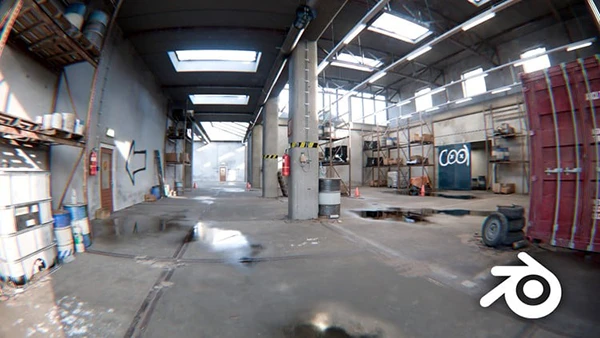
Construct a complete industrial factory hall from blueprints, modeling structural elements including construction beams, pillars, doors, and light systems. Learn professional workflows for organizing large scenes, creating realistic materials like puddles and wall dirt, and adding environmental details through geometry node scattering.
Natural Environment Creation (Blender 3.2)
Master organic landscape building by creating procedural grass systems, animated trees, and terrain displacement using Geometry Nodes. Develop forest paths, water features, and atmospheric fog while learning to blend multiple material layers for realistic ground surfaces.
Advanced Scene Development
Build diverse environments including ruined landscapes with castle structures, forest farmhouses with rivers, sunset castle scenes, and mountain ruins. Each project teaches material blending, vertex painting, photoscanned asset integration, and strategic use of high-resolution versus proxy models for performance optimization.
Technical Workflows and Tools
Gain proficiency with Geometry Nodes for vegetation scattering and terrain modification, cloth simulation for tarps and plastic wrapping, the Blender compositor for post-processing, and camera animation techniques. Work with 4K and 8K PBR textures alongside a library of 150+ photoscanned assets.
You may also be interested in these courses:
- Scott Harris – Character Art School: Complete Coloring & Painting Course (Download)
- Mike Freeman – AutoCAD Complete Course (Download)
Authentic, Real-World Learning
Unlike courses relying on artificial or generic examples, this training emphasizes authenticity. All environments draw from real-world industrial locations with actual reference footage—no AI-generated content. This approach develops your eye for genuine detail, aging, and the subtle imperfections that make environments believable.
Course Structure
The curriculum progresses logically from simple interior spaces to complex outdoor landscapes. Early chapters establish core competencies before advancing to multi-layered material systems, advanced geometry node networks, and large-scale scene composition. Each lecture builds specific skills through hands-on creation rather than passive theory.
Downloadable project files accompany each section, allowing you to follow along precisely and compare your results. The course updates focus on Blender 5, though Blender 3.2 content remains accessible for those exploring previous workflows.
Why This Course Stands Out
This bootcamp excels at making complex environmental art accessible to complete beginners while maintaining professional standards. You’ll create portfolio-worthy scenes demonstrating competency in modeling, texturing, lighting, and composition—all essential for environment artist positions in games and film.
The combination of structured fundamentals and creative freedom helps you develop both technical skills and artistic vision, understanding not just how to use tools but when and why to apply specific techniques for maximum impact.
Begin building the stunning 3D worlds you’ve always imagined and discover why environment creation remains one of the most rewarding disciplines in digital art.